
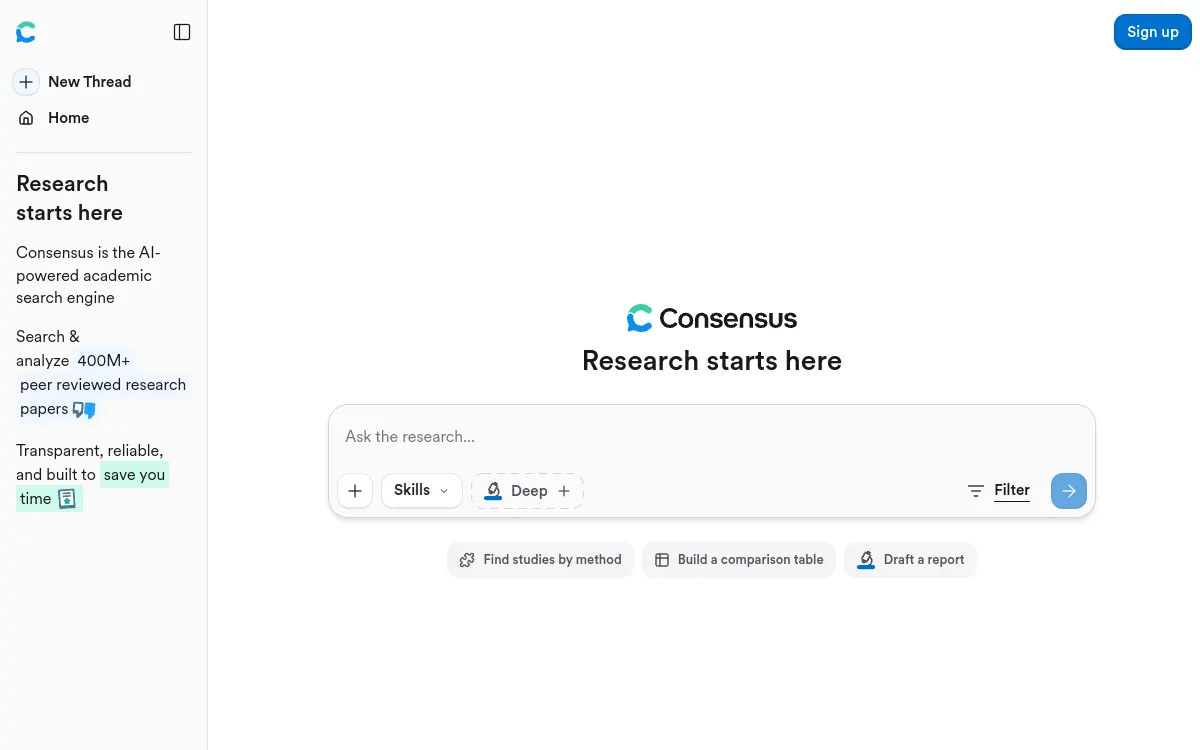
Consensus
Search 200M papers and get evidence, not opinions
Consensus answers questions with findings extracted from peer-reviewed papers, including a consensus meter across studies.
- Starting price
- $12
- Free plan
- Yes
Starter prompts
Copy one into Consensus and swap the {braces} for your own details.
- Summarise the current consensus on {question} and cite the sources you used.
- Compare {option A} and {option B} on {criteria} and say which wins.
- Find the most recent primary sources about {topic} and list them with dates.
Overview
Built for evidence-based questions: 'does magnesium improve sleep?' returns a synthesis plus individual study cards with sample sizes and effect directions. The consensus meter shows how many papers agree, which is more honest than a single confident answer.
Key Features
Study-level extraction
Sample size, population and outcome pulled per paper.
Consensus meter
Visual split of yes / no / mixed findings.
Quality filters
Restrict to RCTs, systematic reviews or recent work.
How to Use
- Ask a yes/no or comparative health question.
- Check the consensus meter and study quality filters.
- Open the underlying papers before citing anything.
Core Advantages
- ✓Real citations with effect directions
- ✓Fast literature scans
- ✓Reduces cherry-picking
Who It's For
Pricing & Free Trial
Free
$0
Pro
$12
Free tier: Unlimited searches, limited AI credits.
Last checked 27 Oct 2026 · source page
Frequently asked questions
- What is Consensus?
- Consensus answers questions with findings extracted from peer-reviewed papers, including a consensus meter across studies.
- Is there a free plan for Consensus?
- Unlimited searches, limited AI credits.
- How much does Consensus cost?
- Consensus uses a freemium model. The entry paid plan is $12 (Pro).
- What can Consensus do?
- Its headline capabilities: study-level extraction; consensus meter; quality filters.
- Who is Consensus for?
- It is aimed at clinicians, students, science writers.
Our Verdict
The most honest research assistant for empirical questions. Useless for topics without published literature.
Community rating
Tap a star to rate this tool
More like this






Compare Consensus with alternatives
Put Consensus next to its closest rivals — ratings, free tiers and entry prices in one table:
 Perplexity★ 4.6
 Semantic Scholar★ 4.5
 Genspark★ 4.4